Viking Refrigerator Warm By Afternoon, Cold Again By Morning
A built-in that holds temperature overnight and loses it after three o'clock is almost never a failing compressor. It is a heat-rejection problem, and in Phoenix that has four usual causes you can narrow down yourself.
Written by
Lucia Esperanza
Service technician — heat load and high ambient · 13 years in the trade
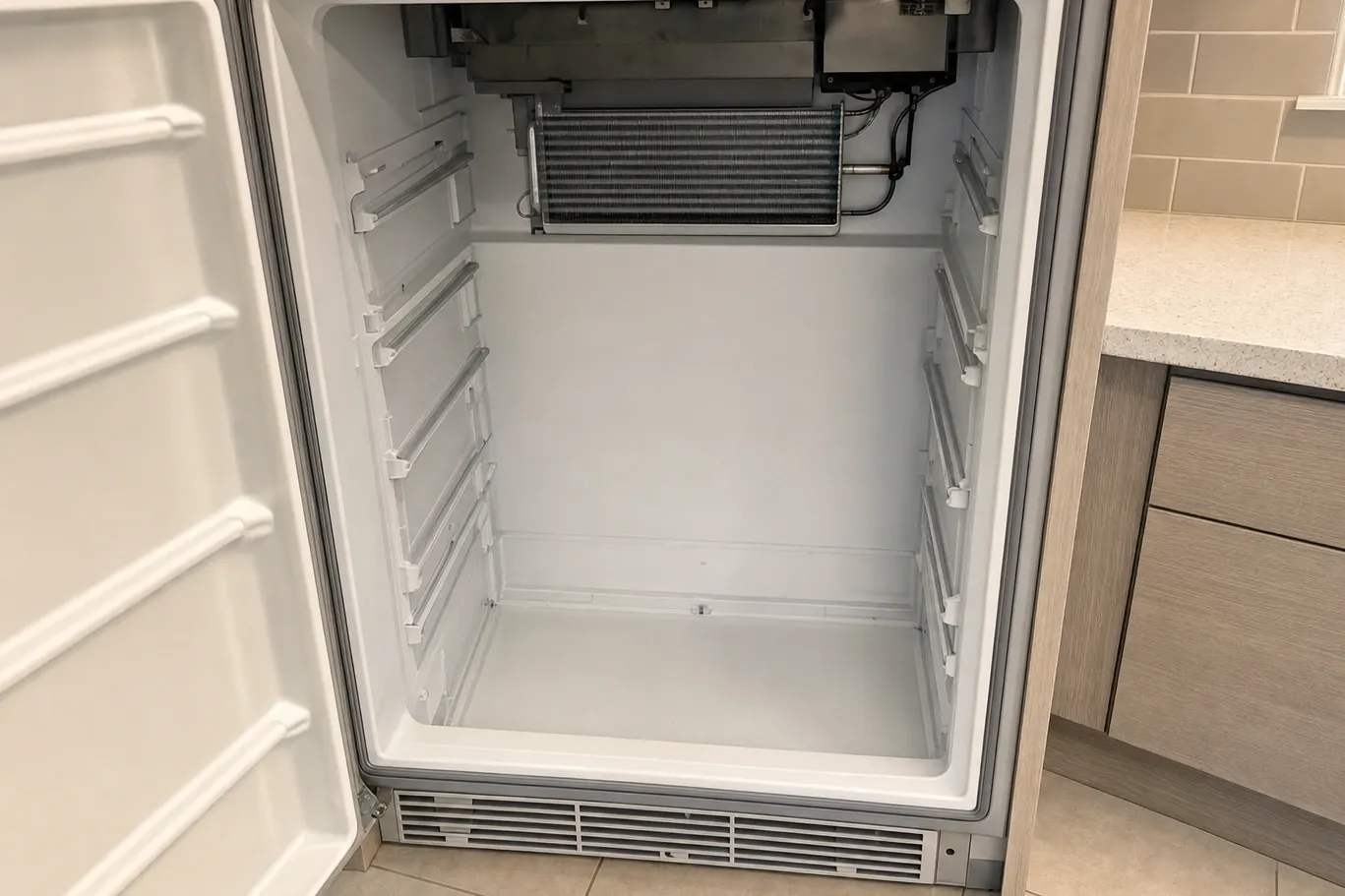
A built-in that reads correctly at seven in the morning and is three or four degrees warm by four in the afternoon is one of the most common calls we take between May and September. It also sounds, to almost everyone who phones about it, like a refrigerator that is on its way out. In practice it is the opposite: the machine is working properly and losing an argument with the room.
No refrigerator creates cold; it relocates heat. In a built-in the heat leaves the cabinet and goes into whatever air happens to be crossing the condenser coil behind the base or top grille, and the entire ability to hold a temperature rests on that coil being able to give its heat up. With the kitchen at 74°F, it can. With the room climbing all day and the air reaching the coil at 88°F, the margin the design left has gone and the compartment drifts. That is why this fault runs on a clock rather than announcing itself as a symptom.
Why the fault follows the time of day
There are two heat loads on any refrigerator: what you put in it, and what the room pushes through the walls and door seals. The second one is the whole story here. As ambient temperature rises, more heat leaks in per hour, and at the same time the condenser’s ability to shed heat falls because the air it is using is hotter. Both curves move the wrong way at once.
A healthy built-in absorbs that. It runs a longer duty cycle, the compressor rests less, and the compartment stays put. The unit only starts losing when something has already eaten the margin: a coil that cannot transfer, a fan that is not moving air, a grille that is blocked, or a door seal letting the room in. Overnight, with the room in the seventies, that same degraded unit has enough margin to catch up completely — which is exactly why it reads perfectly when you check it in the morning and convinces you the problem went away.
So the pattern itself is diagnostic. A unit that is warm at all hours has a different fault. A unit that is warm only when the house is warm is telling you the heat is not getting out.
The four things that cause it, in order of likelihood
A silted condenser coil. By a wide margin the most common. The coil is a fine aluminium matrix and it works by air passing between its fins. Dust from open ground, grit driven in by a dust storm, pet hair and kitchen grease pack that matrix until it is effectively a solid plate. The compressor then runs continuously against a condenser that cannot transfer, head pressure climbs, and efficiency collapses. Pull the base grille and look at it with a torch: if the fins look grey and felted rather than like a comb, that is your fault.
A condenser fan that is not turning, or not turning properly. The fan is what makes the coil work at all in a built-in, because there is no natural airflow behind cabinetry. A seized bearing, a blade fouling its shroud, or a fan running slow on a tired motor produces the same result as a dirty coil. With the grille off you should hear and feel air moving whenever the compressor is running.
A blocked or boxed-in grille. Remodels do this constantly. A toe-kick trim piece, a new floor laid proud of the old one, a filler panel or a cabinet returned tighter than the original all reduce the opening the appliance breathes through. The appliance was not modified, so nobody suspects it.
Door seals and alignment. A gasket gone hard, a door that has settled on its hinge, or a seal that no longer touches along the top edge admits warm room air around the clock. It is an easy test to do badly and an easy one to do well: pinch a strip of paper in the closed door and pull it straight out. Any stretch of seal that releases the paper without dragging on it is not sealing.
What to check yourself, and what to leave alone
Everything in this list is safe with the appliance plugged in, except where noted.
- Read the actual temperature with a separate thermometer in a glass of water, left for two hours. Display readings on built-ins are averaged and lag badly.
- Pull the base grille off — usually two screws or a clip — and look at the coil.
- Vacuum the coil with a brush attachment and finish with a coil brush pushed between the fins. Do not use a screwdriver or anything that can bend a fin flat.
- With the compressor running, check the fan is turning and that you can feel air leaving the grille.
- Check nothing has been added over or in front of the grille since the kitchen was last worked on.
- Do the paper test on all four edges of each door.
- Note whether the compartment recovers overnight. That single fact tells a technician more than any other observation you can give them.
What to leave alone: anything with a gauge port on it, the compressor, the wiring behind the control panel, and the evaporator cover inside the cabinet. Sealed-system work needs certification and recovery equipment, and guessing at it does real damage to a unit that usually did not need it.
When it stops being a maintenance job
If the coil is clean, the fan moves air, the grille is clear and the seals hold, and the compartment still drifts every afternoon, the problem has moved inside the sealed system or into the controls. The usual candidates are a low refrigerant charge from a slow leak, a partially restricted capillary or drier, a failing evaporator fan, or a thermistor reading warm and telling the control the cabinet is colder than it is.
Those are all measurable, and none of them are guessable. Superheat and subcooling readings separate a leak from a restriction in about twenty minutes. A clamp meter on the compressor tells you whether it is drawing what it should. A thermistor is a resistance check against a table. That is the point at which a visit earns its money, and it is also the point at which somebody without instruments will start replacing parts and charging you for the misses.
If your unit is on its second or third summer of this behaviour, mention that on the phone. A refrigerator that has run continuously through several Phoenix Augusts has usually been worked hard enough that the compressor’s own condition is worth measuring at the same time, and it changes what is worth doing in one visit.
Follow-up questions
-
Is it safe to keep using the refrigerator while it is doing this?
Watch the temperature rather than the food. If the fresh-food compartment is holding under 40°F through the worst part of the afternoon you are inconvenienced, not at risk. If it climbs above that for more than four hours, move anything raw to a cooler or the freezer and stop opening the door — every opening dumps in humid air the unit then has to pull back out.
-
How often does a condenser coil actually need cleaning here?
Twice a year is realistic in this valley, and once a year is the minimum. Anywhere near open ground, a construction lot or a farm field, treat it as every four months. That is far more often than the manual assumes, because the manual was not written for a kitchen that breathes field dust and haboob grit.
-
The kitchen has recessed panels over the top of the unit. Does that matter?
It matters a great deal. A built-in rejects its heat through a grille at the base or the top, and cabinetry that boxes that grille in turns the appliance into its own oven. If a remodel added trim, a wine rack or a filler panel over that opening, that alone can produce exactly this pattern with nothing wrong inside the machine.
-
Would a warm afternoon explain frost building up as well?
Indirectly, yes. A unit that runs almost continuously never gets a proper defrost interval, so the evaporator ices progressively and airflow drops, which makes the warm compartment worse. Frost plus afternoon warmth usually means the same root cause, not two faults.
refrigeratorcoolingcondenserdiagnosticsheat